
NERC grant awarded to investigate new model of Earth's magnetic field
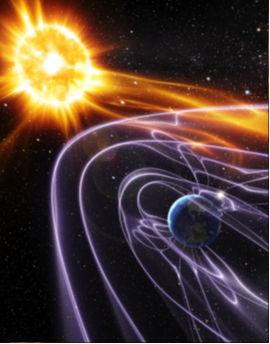
Data-driven models of the fluid dynamics of Earth’s core that explain and predict Earth’s magnetic shield
Fluid dynamics takes many forms, but perhaps one that many of us don’t appreciate is the churning ball of molten iron at the centre of our planet that generates Earth’s magnetic field. This magnetic field shields our planet from harmful solar radiation, protecting our atmosphere in which life has thrived, and sheltering modern electrical infrastructure such as satellites and power grids from space weather. Yet our planetary magnetic shield has a dent, or low intensity zone, called the south Atlantic anomaly, a vast area of space currently between South Africa and Chile, in which spacecraft in low-Earth orbit are exposed to damaging radiation. The south Atlantic anomaly is currently growing and deepening, which might have major implications for the sustainability of satellites, underpinning diverse technologies such as weather forecasting, navigation, communication, television, banking transactions and internet provision. However, due to severe computational challenges, current numerical models of this geodynamo cannot faithfully describe the correct fluid dynamics, leaving major gaps in our understanding of how the global magnetic field is created and how it changes through time.
In a recent grant (£950k) funded by the Natural Environment Research Council (NERC), a team comprising Leeds Institute for Fluid Dynamics researchers Prof Chris Davies and Prof Phil Livermore in the School of Earth and Environment at Leeds, and the British Geological Survey, seek to develop a new type of model of Earth’s magnetic field. The new approach leverages both recent advances in observational data and a new data-driven machine learning method called physics-informed neural networks. These models will obey all the appropriate physics while matching high resolution satellite data, providing an unprecedented opportunity to image the dynamics inside the core.
For further information about this project please contact Prof Phil Livermore or Prof Chris Davies.